
Street stall dishwashing setups, how to spot clean plates by rinse-bucket order, foam color, and towel habits
A great street meal should come with one basic promise: the plate and utensils won’t ruin your day. The tricky part is that you usually can’t inspect a kitchen, you can only see what’s happening in the open.
That’s where street food dishwashing tells its own story. With a quick glance at bucket order, foam color, and towel habits, you can often tell whether a stall is running a clean workflow or just moving grime around. This guide from Street Food Blog shows what to look for in real time while you’re in line.
Start with the “flow”: dirty should never travel backward
The best dishwashing setups feel like a one-way street. Dirty plates enter at one end, clean plates exit at the other, and nothing loops back.
When a stall is busy, speed can tempt people to “shortcut” steps. That’s when you see a clean plate dipped into the wrong bucket, or a rinsed spoon tossed back into soapy water with food scraps. Those small reversals matter because they re-contaminate items that were almost clean.
Health departments often describe manual washing as a sequence of wash, rinse, and sanitize, with clear separation between steps. If you want a plain-language reference for what regulators expect, see the manual dishwashing procedure from the Georgia Department of Agriculture amazon affiliate marketing.
Rinse-bucket order: the fastest way to spot a clean setup
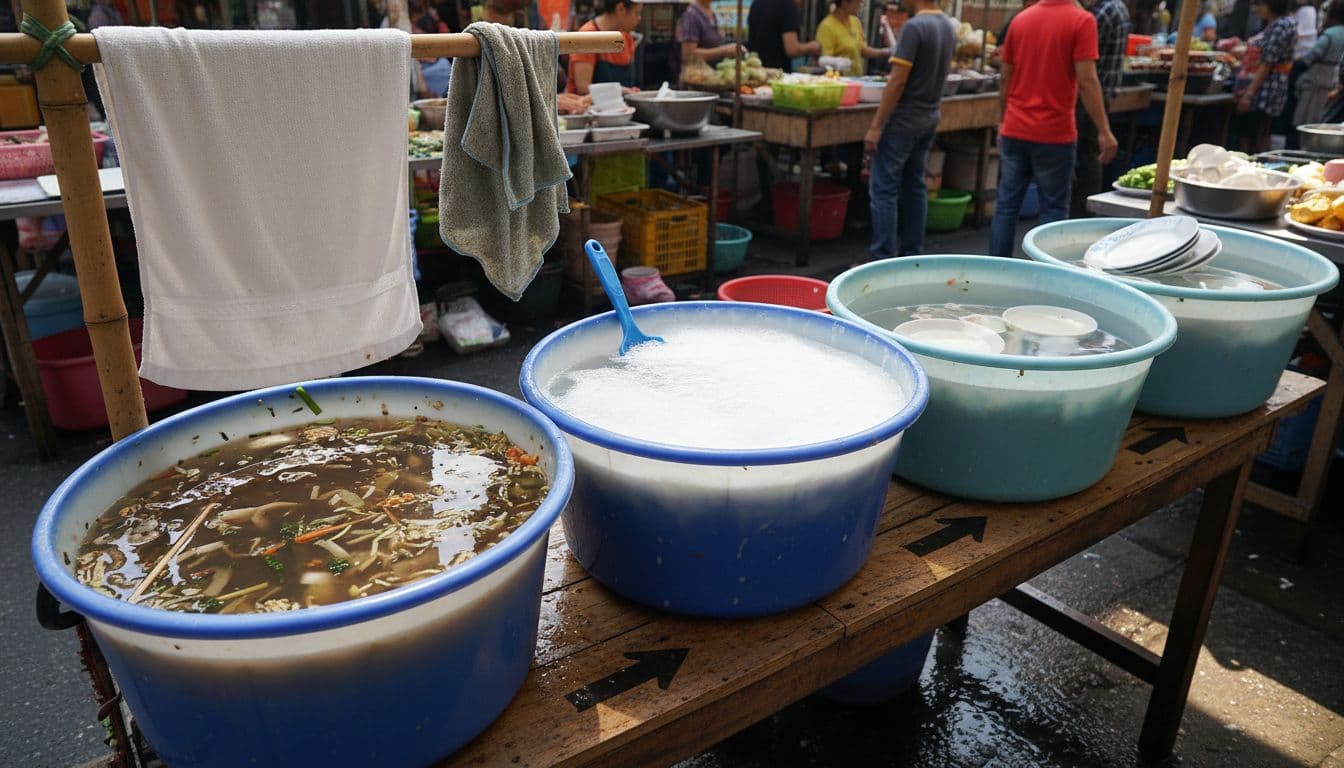
Most street stalls don’t have a full three-compartment sink, so they improvise with tubs, buckets, or basins. That’s fine, as long as the order makes sense.
A practical “good” layout (even if it’s simple)
Look for a left-to-right (or front-to-back) progression that resembles:
- Scrape or pre-rinse: the dirtiest water, where food bits come off first.
- Wash with detergent: the soapy bucket where scrubbing happens.
- Final rinse: the cleanest water, used after washing.
Sometimes you’ll see a fourth container for sanitizer in markets with stricter rules, or at organized festivals. Even if you don’t know the local regulations, the logic is the same: each step should get cleaner than the last.
A quick reading guide (what the bucket order usually means)
| What you see at the stall | What it often indicates | What to do as a customer |
|---|---|---|
| Three buckets in a clear line, clean plates stacked away from the dirty side | A consistent routine, less backtracking | Lower risk, still watch towel use |
| Only one bucket, everything goes in it | “Shared bath” washing, water gets dirty fast | Consider choosing another stall |
| A rinse bucket placed before the wash bucket | Rinsed items may get dirty again | Watch if rinsed plates return to soap |
| Clean plates resting near dirty pans and scraps | Cross-contact risk | Ask for a fresh plate or packaged utensil |
You’re not judging a vendor’s character, you’re judging the system. A good system keeps working even when the rush hits.
Foam color tells you when “wash” water stopped washing
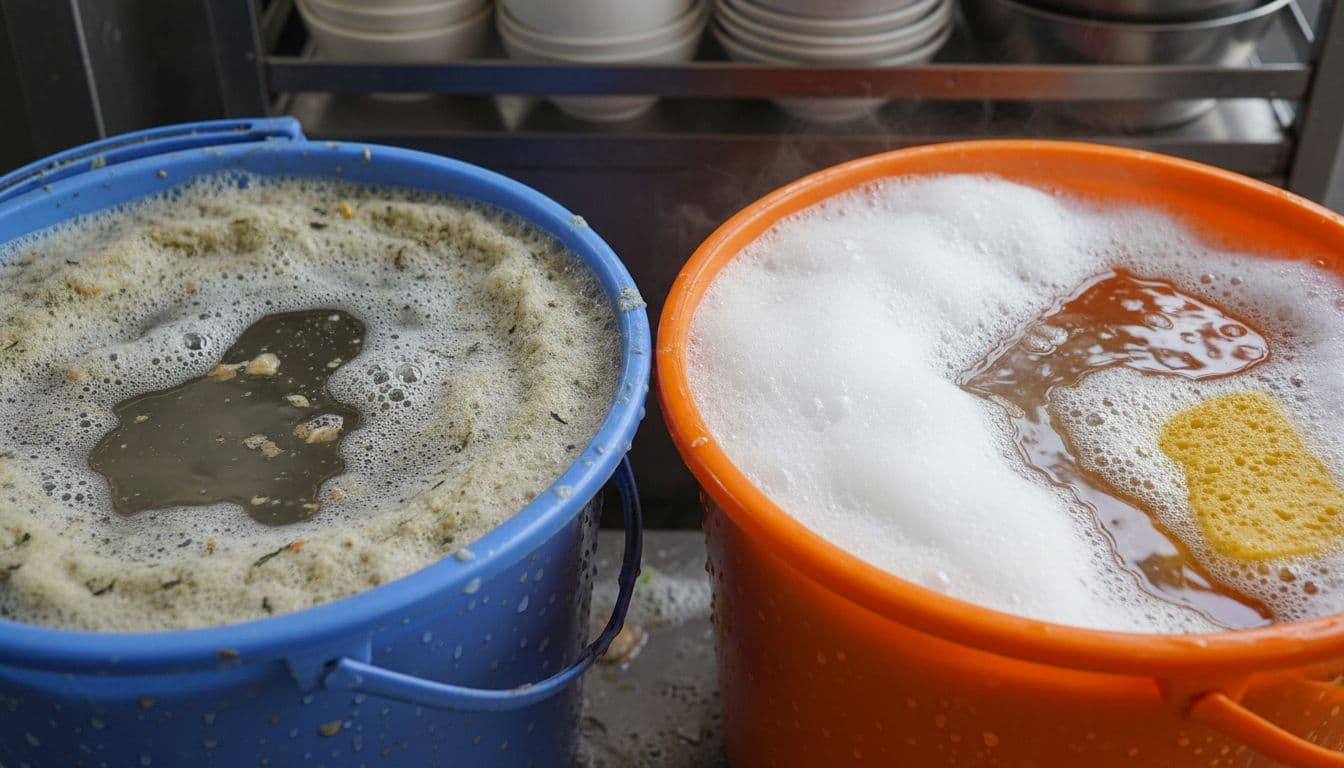
If bucket order is the map, foam color is the weather report. It changes fast, and it’s hard to fake.
What “good” foam tends to look like
Fresh detergent foam is usually white or light. It can be thin, not a bubble mountain, but it should look clean. The water under it shouldn’t be the color of soup.
You might also notice that the scrubbing tool (brush or sponge) is used in the wash bucket, not dropped into the rinse bucket.
What “bad” foam often looks like
Old wash water can turn gray, tan, or brown, with a greasy sheen. Foam gets patchy and sticky-looking, like it’s carrying yesterday’s oil.
A strong sour smell is another clue. Odor is not proof of danger, but it often signals that water has been used too long.
If you want to understand the common three-tub method used in field settings (wash, rinse, sanitize), this video on safely washing dishes in the field explains the basic idea in a simple way.
The final rinse bucket: clarity matters more than bubbles
The rinse bucket is where you can spot “almost clean” versus truly clean.
A good final rinse looks clear enough that you can see the bottom. It doesn’t need to sparkle, but it shouldn’t have floating herbs, oil circles, or a layer of foam. Foam in the final rinse often means soap is being carried over, or the rinse bucket is doubling as a second wash bucket.
Also watch the motion: clean items should go from wash to rinse, then out to a clean area. If plates keep dipping back into earlier buckets, the rinse doesn’t count for much.
For a broader checklist of mobile unit hygiene practices (including equipment and cleaning expectations), the NACCHO mobile food unit best practices factsheet is a solid reference.
Towel habits: the quiet giveaway most people miss
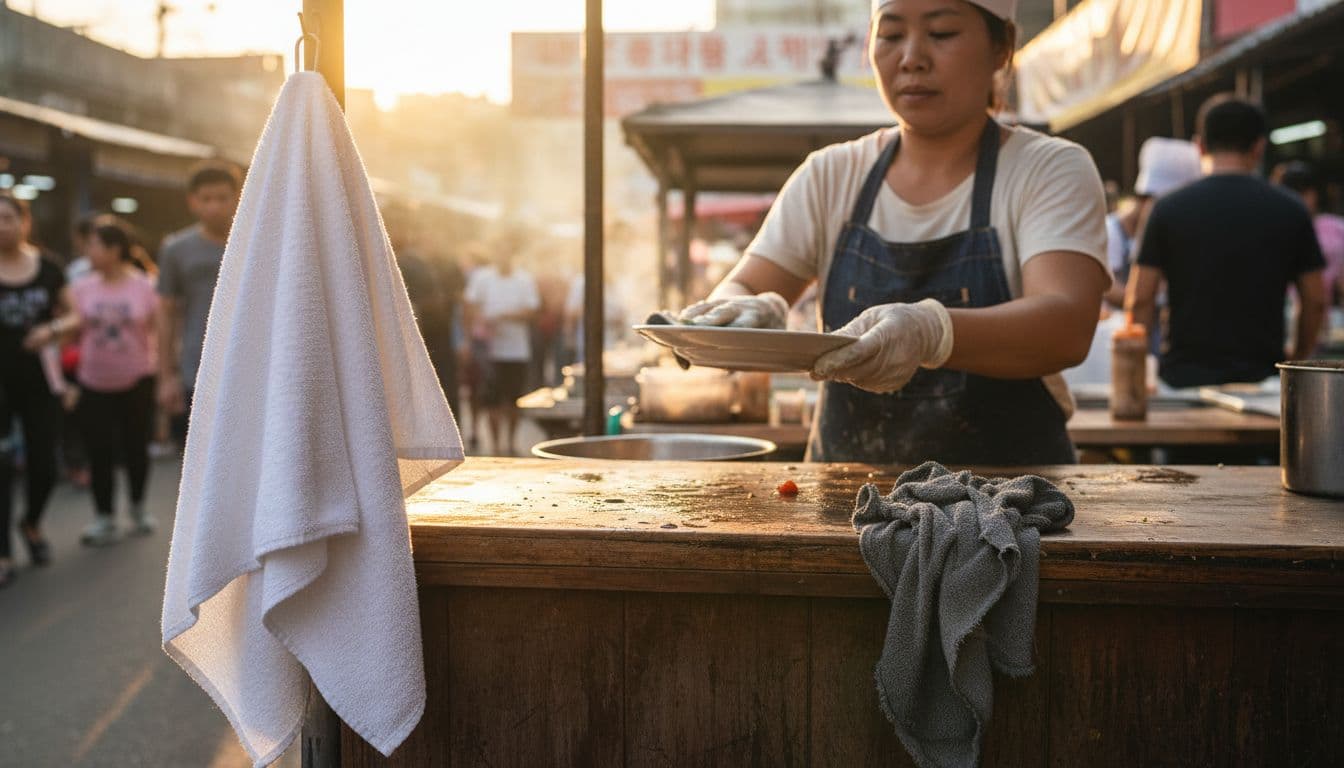
Towels look harmless, but they can be the biggest source of re-contamination. A towel is basically a sponge with a memory.
Cleaner towel habits to look for
Two-towel logic: one towel (or paper) for drying clean dishes, another rag for wiping counters and spills. Better still, air-drying racks for plates and utensils.
You’ll also see clean towels kept higher up, away from the dirty bucket area, and not used on hands, money, and plates all in the same minute.
Red-flag towel habits
One rag used for everything: wiping sweat, wiping the cutting board, wiping a plate, then wiping the ladle handle.
Another common issue is a towel that stays wet all day. Wet fabric holds grime, and it spreads it with every wipe.
A fast, real-world checklist while you’re waiting to order
Use this as a 10-second scan, not a deep inspection:
- Bucket order makes sense (dirty to clean, no backtracking).
- Final rinse looks clearer than the wash water.
- Foam stays light, not gray and oily.
- Clean items land in a clean zone (a rack, a covered tub, or a clean tray).
- Towels are separated, or plates air-dry instead of being wiped.
If two or three of these feel off, it’s reasonable to pick a different stall.
If you’re unsure, here’s how to order smarter
Choosing safer street food isn’t about fear, it’s about odds.
Pick busy stalls with steady turnover, since plates and water are more likely to be refreshed. Watch for vendors who reset their station, even briefly, during slow moments. If you’re on the fence, you can ask for a disposable plate, or choose foods served on fresh paper, banana leaf, or single-use bowls when that’s common locally.
Trust your eyes. A clean workflow looks calm, even when the line is long.
Conclusion
Street food is one of the best ways to understand a city, but the plate in your hands should be as trustworthy as the flavors. By reading rinse-bucket order, foam color, and towel habits, you can spot street food dishwashing that’s built for cleanliness, not just speed. Next time you’re in line, take a quick look at the buckets and towels before you order. Your stomach will thank you later.



Maximizing Your Earnings with Amazon Affiliate Marketing: A Comprehensive Guide to Passive Income
[…] How to Get Started with Amazon Affiliate Earnings […]