
You’re standing at a busy stall, the line’s moving fast, and the food smells unreal. Then you see the cutting board. Is it clean, or just “looks fine” from a distance?
Good street food hygiene checks don’t need a lab test or a long lecture. With a quick, practiced scan, you can judge whether a prep surface is being cleaned often, cleaned the right way, and used in a way that limits cross-contamination. This guide gives you a 15-second routine you can use anywhere, from night markets to curbside grills, without making a scene (or missing your order).
The 15-second street stall surface check (what you’re really looking for)
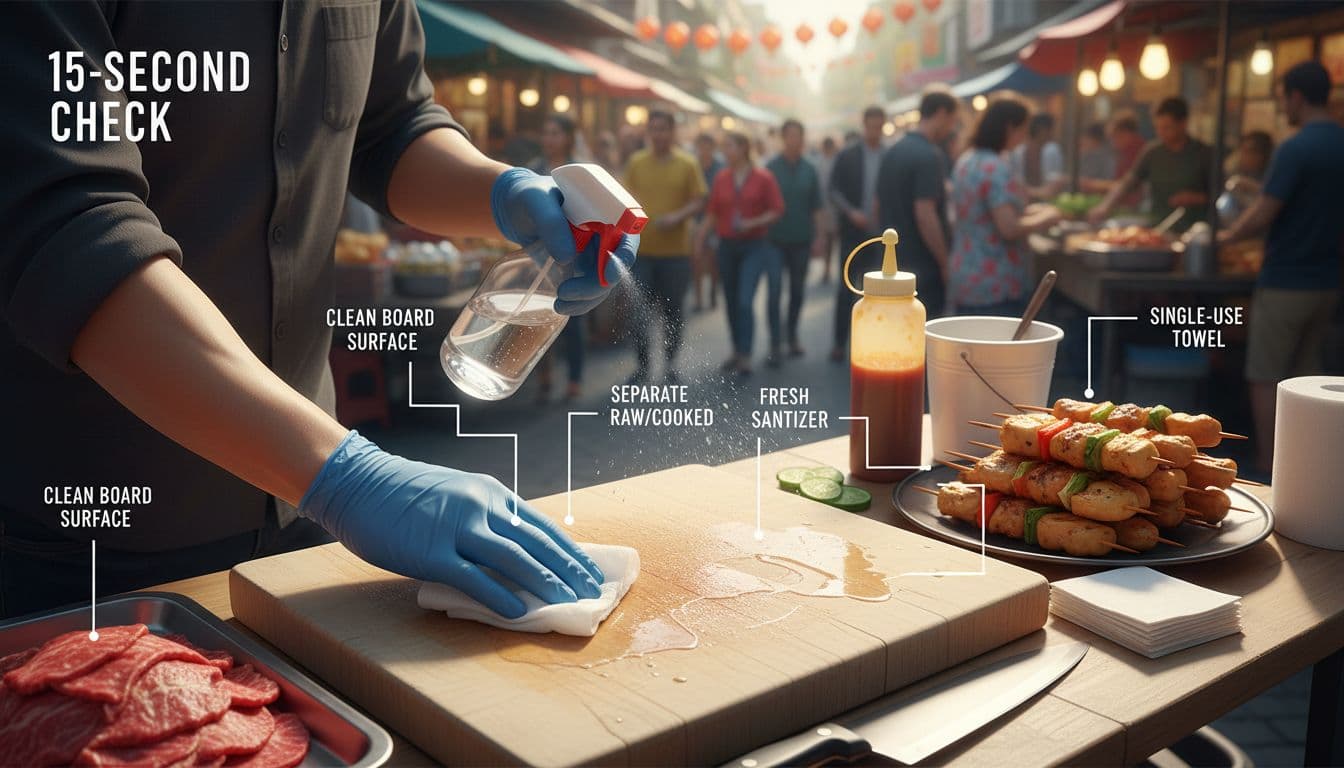
When you only have seconds, don’t try to inspect everything. Focus on three signals that matter most:
- Surface condition: Is the board physically cleanable right now, or is it full of cuts, grime, and trapped residue?
- Cleaning behavior: Do you actually see wipe-downs between tasks, not just at the end?
- Workflow separation: Do raw and cooked foods have their own zones, tools, or timing?
Here’s a fast cheat sheet you can keep in your head.
| What you can see fast | What it often means | Your move |
|---|---|---|
| Board looks smooth, recently wiped | Dirt isn’t building up in grooves | Low concern |
| Vendor wipes, then uses a fresh towel | They’re not spreading mess around | Good sign |
| Raw items kept away from cooked items | Lower cross-contamination risk | Better choice |
| Same wet rag used all day | The “cleaning” can re-contaminate | Caution |
| Deep grooves, dark staining, sticky sheen | Hard to sanitize well during service | Consider skipping |
(If you want the deeper science behind why boards and knives need proper cleaning between raw and ready-to-eat foods, the USDA FSIS cutting board guidance is a solid reference.)
Second 1 to 5: Read the cutting board like a map, not a photo
A clean board isn’t always a bright white board. At street stalls, boards get stained. What matters is whether the surface still behaves like something you can clean.
Look for:
1) The “sheen test”
A board that looks wet in patches, glossy, or slightly tacky can signal grease buildup or old residue. Fresh moisture from a quick rinse looks different, it’s even and tends to evaporate.
2) The groove problem
Knife cuts are normal. Deep grooves are not. Grooves hold food bits and moisture, and they’re tough to sanitize quickly in the middle of service. If the board looks like a tiny canyon system, that’s a red flag. Commercial kitchens often resurface or replace boards for this reason (this article on how chopping board resurfacing supports food hygiene explains the issue clearly).
3) The crumb trail
Scan the corners and edges. If scraps are stuck along the rim, it hints the board hasn’t been properly cleared or wiped in a while.
This part is about surfaces being cleanable, not about perfection. A board can be ugly and still well-managed, but it shouldn’t be sticky, gunky, or deeply scored.
Second 6 to 10: Watch the wipe-down, because motion tells the truth
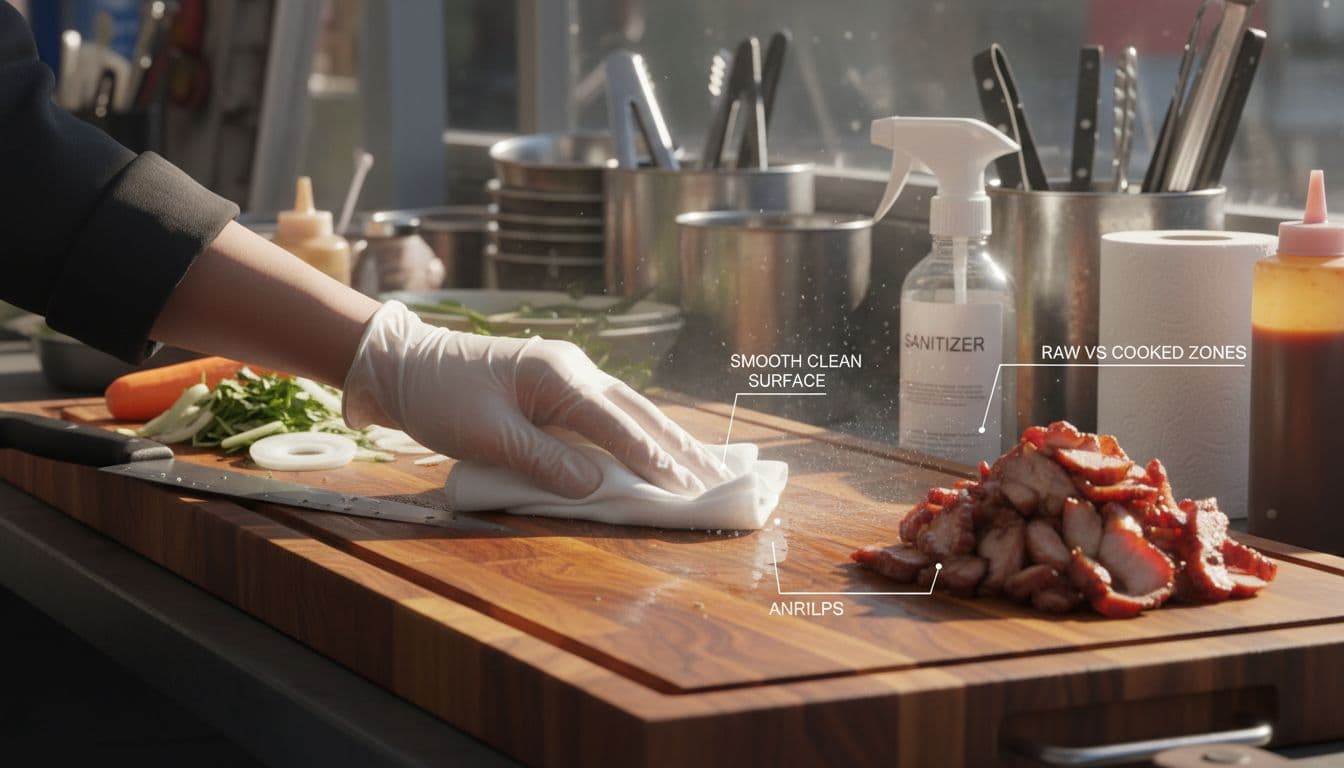
A stall can look tidy and still handle cleaning poorly. The giveaway is the wipe itself.
Here’s what a good “between tasks” clean often looks like in real life:
Clear debris first: They scrape or move scraps off the board, so they’re not grinding food into the surface.
Wipe with purpose: One or two firm passes, not a lazy swirl.
Fresh towel behavior: They switch towels, grab a paper towel, or rinse a cloth properly instead of reusing the same damp rag forever.
A quick reality check: wiping alone is not the same as sanitizing, but consistent wiping between raw and cooked steps reduces how much contamination can build up on a busy station. For practical cleaning and sanitizing basics (and what “sanitize” actually means in food settings), this StateFoodSafety guide to cleaning and sanitizing cutting boards is useful context.
The biggest “fake clean” you’ll see
A cloth rag that’s always wet and always in the vendor’s hand can become a portable contamination tool. If it smells sour, looks gray, or leaves streaks, it’s not helping.
Second 11 to 15: Check raw vs cooked separation in one glance
This is the part most people miss because they’re staring at the food, not the workflow.
You’re looking for simple separation habits, like lanes on a road:
- Raw zone: raw meat, seafood, eggs, and their juices
- Ready-to-eat zone: cooked meat, chopped herbs, garnishes, bread, tortillas, buns
Separation can be done in different ways, and any one of these can be enough:
Different boards: the clearest signal.
Different tools: one knife for raw prep, another for cooked slicing.
Different timing: raw prep happens first, then the board gets cleaned before cooked food touches it.
Physical distance: raw items sit in a tray off to the side, not on the same board where cooked food is being portioned.
A simple visual cue: cooked food should not “park” next to raw drippings. If you see cooked slices resting in the splash zone of raw prep, that’s the moment to reconsider.
(For more general street vendor safety practices, this overview on safe practices for street food gives a broader picture of what good setups try to do.)
Quick red flags that beat a perfect-looking stall
Some stalls look spotless because everything’s hidden. Others look chaotic but run a clean system. These are the red flags that matter most for street food hygiene, even if the stall looks “Instagram clean”:
Old cloth + shared bucket water: A single bucket used for rinsing hands, wiping boards, and soaking utensils is a common weak point.
Same gloves touching everything: Gloves don’t equal cleanliness if the same pair touches raw food, money, and cooked food.
Board used as a landing pad: Phones, cash, dirty tools, and packaging shouldn’t touch the prep surface.
Knife never leaves the board: If a knife goes from raw trimming to slicing cooked meat without a reset, that’s a risk.
Think of the board as a cutting surface and also as a “shared plate.” Anything that touches it becomes part of your meal story.
If you’re not sure, order smarter (without making it awkward)
If your 15-second scan leaves you uneasy, you don’t need to interrogate the vendor. You can simply choose lower-risk options:
Pick high-heat foods: items cooked to order on a hot griddle, wok, or fryer.
Skip raw garnishes: ask for no raw salad, herbs, or chutney added at the end if the prep area looks questionable.
Choose sealed drinks: bottled water or canned drinks when the ice handling looks messy.
Watch the rush: peak crowds can push even good vendors into shortcuts.
Street Food Blog readers already know the best stalls often have lines. The trick is pairing that local buzz with a fast, calm hygiene read.
Conclusion: Make the 15 seconds count
You don’t need to be a food inspector to spot the basics. In 15 seconds, you can judge whether a cutting board is cleanable, whether wiping habits actually reduce mess, and whether raw and cooked foods stay in their own lanes. That small habit keeps street food fun, not stressful. Next time you step up to a stall, run the scan once and trust what you see.

Leave a Reply