
A street stall seafood boil is part dinner, part live show. The pot thunders, steam curls into the night air, and a vendor works fast with tongs and a lid that never fully settles. If you’ve ever watched that scene and wondered how they know it’s ready, you’re not alone.
Getting seafood boil doneness right is harder than it looks. A single pot can hold shrimp, crab, clams, corn, and potatoes, all cooking at different speeds. Add wind, crowds, and the need to serve quickly, and the checks have to be simple, fast, and repeatable.
On Street Food Blog, we care about what you can spot with your own eyes at the stall. These three cues, bubble strength, shell cracks, and steam escape, are the street-smart way to read the pot.
Why street-stall seafood boils need “visual science”
In a home kitchen, you can set a timer and hover. At a night market, the vendor is juggling orders, heat control, and portioning. That’s why good stalls rely on signals that can’t be faked: the boil’s energy, the shell’s behavior, and how the pot vents.
None of these checks replace food-safety basics. They do help you understand what’s happening, and they make it easier to choose a stall that’s cooking with care.
Bubble strength check: reading the boil like a heartbeat
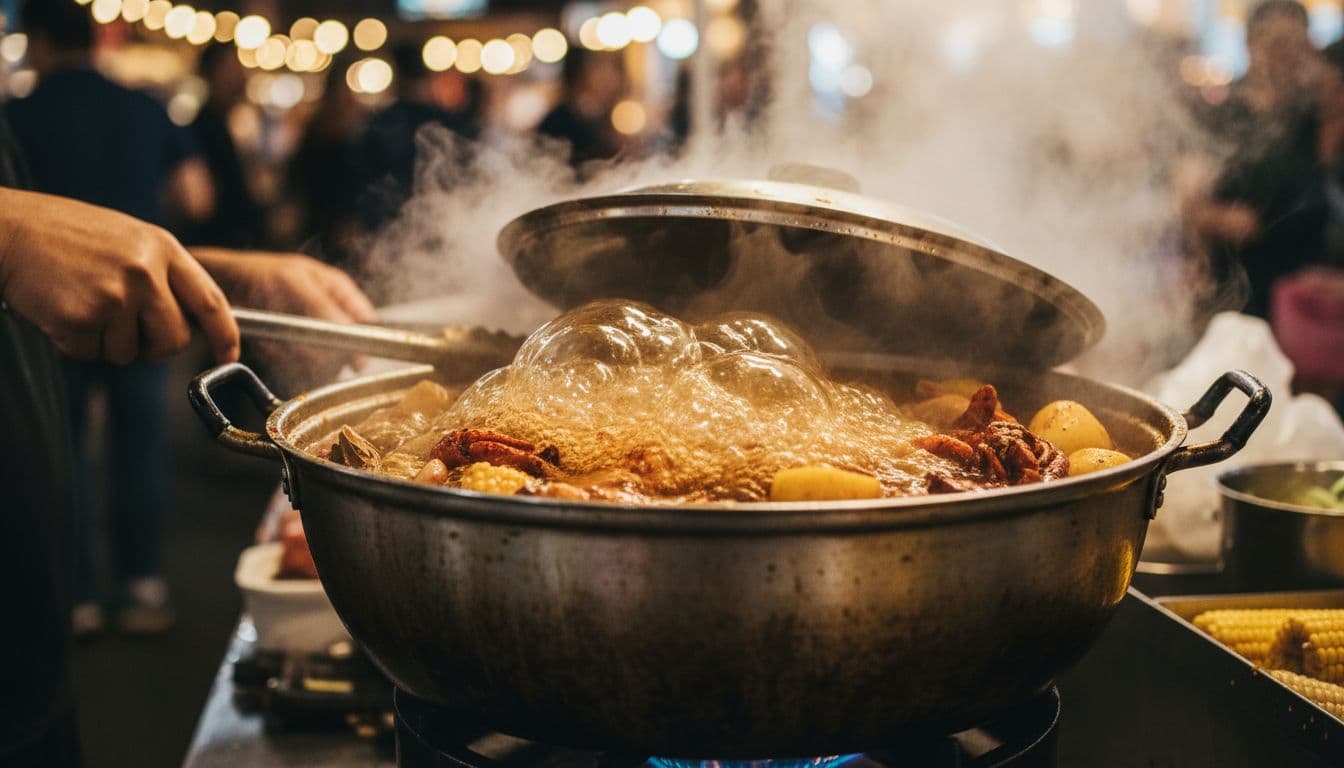
Bubble strength is the quickest “is the pot doing its job?” test. A rolling boil has large, forceful bubbles that keep breaking the surface across the pot, even when the lid is nudged on top. A weak simmer looks lazy, with small bubbles only around the edges.
For street seafood boils, bubble strength matters for two reasons:
First, seafood cools the water fast. When a vendor drops in a basket of shellfish, the boil often collapses for a moment. A skilled vendor waits for the pot to climb back to an active boil before starting the real cooking window. If they scoop too soon while the pot is still recovering, you risk uneven doneness.
Second, the boil is also a mixing tool. Strong bubbling keeps spices moving and helps heat reach the center of the pile, especially when corn and potatoes are packed in tight.
Lids are part of the bubble story. A lid traps heat and gets you back to a boil faster, but a fully sealed lid can hide what’s happening. Many vendors keep it slightly offset so they can hear and see the boil, and so steam can vent.
A practical reference on heat control and boil management (especially for crawfish-style boils) is this guide on temperature control for a perfect boil. The point isn’t to copy a single recipe, it’s to notice how much attention pros pay to maintaining the right boil energy.
A quick bubble-strength checklist at the stall
- Strong boil returns quickly after new seafood hits the pot.
- Bubbles are active across the surface, not just at the edges.
- Steam is steady, not faint and on-and-off.
Shell cracks and shell-open cues: what’s normal, what’s a warning
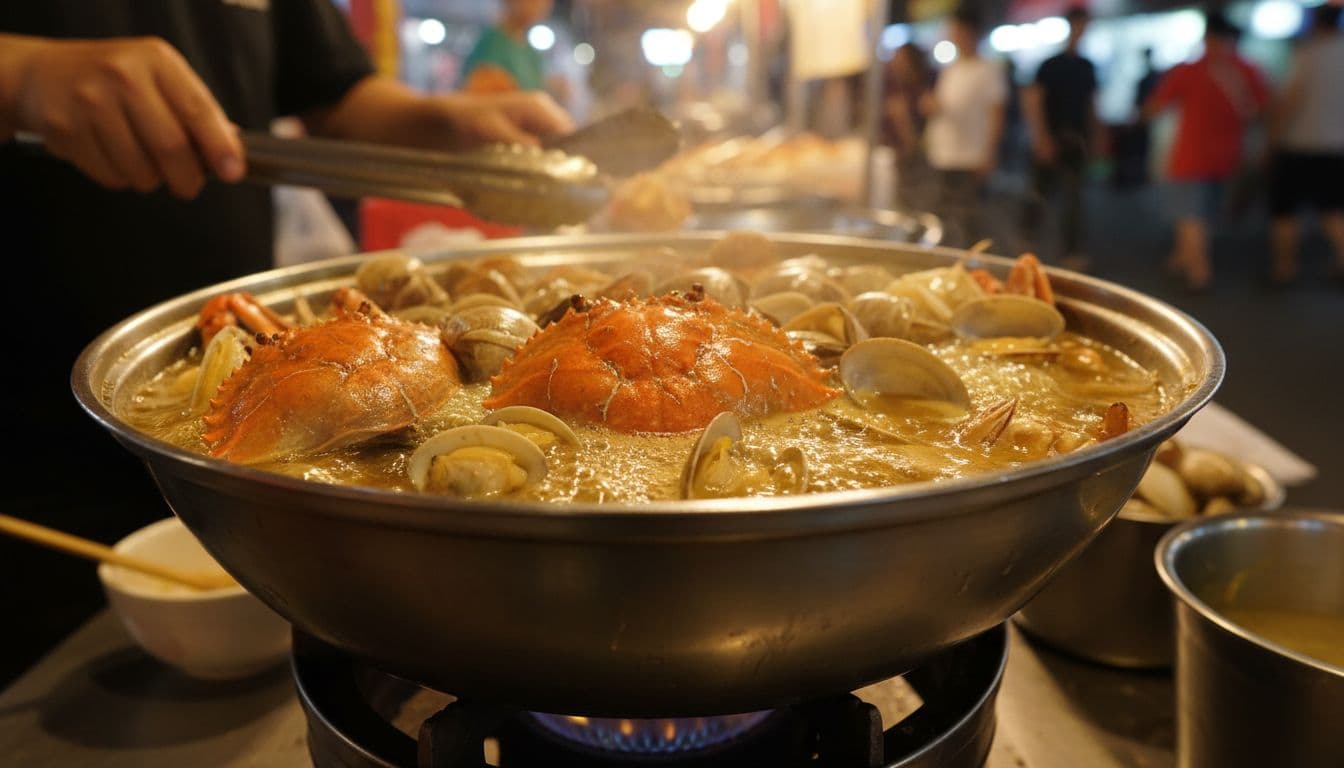
“Shell cracks” can sound alarming, but some cracking is expected. Heat builds pressure inside shells, and that pressure looks different depending on what’s in the pot.
Crustaceans (crab, lobster, crawfish, shrimp)
- Shrimp tend to turn opaque and firm. The risk is overcooking, which makes them tight and bouncy.
- Crab and lobster may show small splits along natural seams or at joints as the shell heats and expands. That can be normal, especially during a strong boil.
What you don’t want to see is lots of shattered shell fragments. That can mean rough handling, or it can mean the pot is being stirred too hard, crushing softer shellfish against harder items like corn.
Bivalves (clams, mussels, oysters)
Shell-open behavior is one of the clearest doneness signals on the street. Many clams and mussels open during cooking. Vendors often scoop them soon after opening to avoid rubbery meat.
A helpful, plain-language overview of these signs is how to know when seafood is cooked, including the common practice of discarding shells that don’t open after cooking.
Here’s a simple way to interpret what you’re seeing.
| Shell sign | Often means | What a good vendor does |
|---|---|---|
| Small seam crack on crab shell | Heat expansion, normal | Keeps cooking, checks thicker pieces |
| Cleanly opened clam or mussel | Likely cooked or close | Pulls soon, avoids long holding |
| Lots of broken shell bits | Handling or over-stirring | Stirs gently, scoops with care |
| Bivalves that stay tightly shut after cooking | Could be dead before cook or not cooked through | Removes and discards |
If you’re watching for seafood boil doneness, shell behavior is one of the best tells because it’s visible even in a crowded stall setup.
Steam escape checks: the lid tells the truth
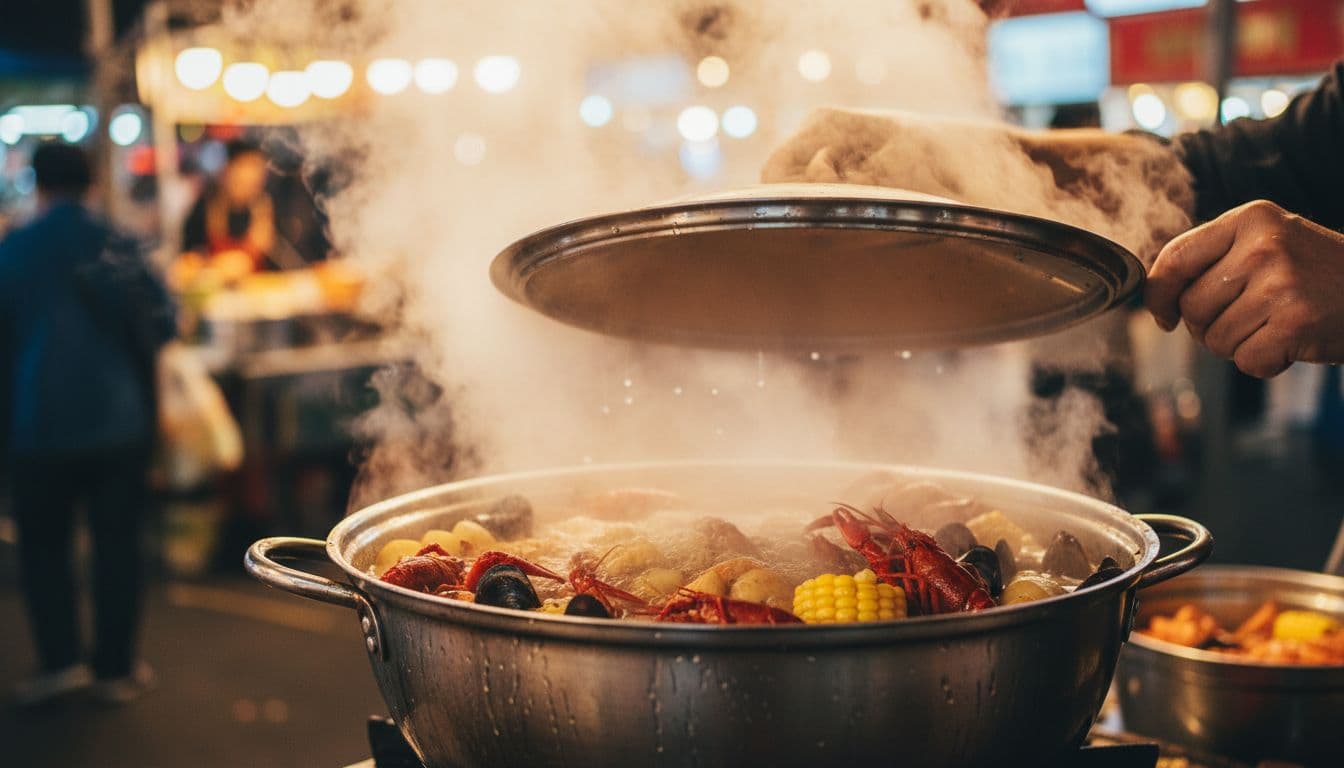
A “steam escape check” is exactly what it sounds like: the vendor lifts or tilts the lid a little and reads what comes out.
When the pot is truly ripping, steam pushes out hard and fast, and condensation beads on the lid edge. When heat is low, steam thins out and the sound drops from a roar to a soft burble. Vendors do this check because it’s fast, and it works even when the pot is full and the surface is hard to see.
Steam checks also help with consistency. If the pot’s steam output looks weak after adding seafood, the vendor knows the boil hasn’t recovered yet. If steam is forceful, they can move to the next step, like adding a final seasoning, starting the short cook window for shrimp, or pulling a basket.
If you’re standing nearby, give them space. A lid lift releases a hot blast, and the safest stalls have a clear workflow where customers don’t crowd the burner.
When visuals aren’t enough: the thermometer and the rules
Street vendors don’t always use a thermometer in view, but the best ones often do, especially for thick pieces or when they’re batching for a rush. Visual cues are great for quick reads, but mixed seafood boils create blind spots. A crab claw can lag behind shrimp. A dense pile of shellfish can insulate the center.
Food-safety rules vary by place, and they’re written for a reason. If you want a sense of what inspectors look for in food service operations, this food service interpretation manual shows how detailed official guidance can get around cooking, holding, and safe handling.
As a traveler, you don’t need to recite regulations. You can watch for good habits:
- The stall keeps the pot actively boiling between pulls.
- Cooked seafood isn’t left sitting in warm liquid for long.
- The vendor separates raw handling from serving tools when possible.
Those habits support reliable seafood boil doneness, even in a fast street setting.
What “done” looks like when it hits the tray
When the vendor dumps the boil onto a tray or into a bag, you get one last chance to read it.
A good street stall seafood boil usually has:
- Open bivalves with plump meat, not dried out.
- Shrimp that bend into a gentle C, not tightly curled into a hard ring.
- Crab shells that look intact, with only minor seam splits, not smashed.
- Broth or sauce that clings, not watery from an under-heated pot.
Texture is the final judge. If everything feels the same, soft and tired, it likely sat too long after cooking. If shrimp are rubbery or clams are chewy, the pot ran hot for too long, or the stall is holding product between orders.
Conclusion: trust the boil, read the shells, respect the steam
Street stall seafood boils reward attention. Bubble strength shows whether the pot has enough energy, shell cracks and openings show how the cook is progressing, and steam escape checks reveal heat stability in real time. Put them together and seafood boil doneness stops being a mystery and starts feeling like a skill you can learn.
Next time you’re at a night market, stand back, watch the lid, and listen to the boil. Then tell Street Food Blog what you spotted, and whether the tray matched the show.

Leave a Reply