


Bangkok Street Food: 15+ Best Places, Dishes and Local Food Experiences in Thailand
Introduction
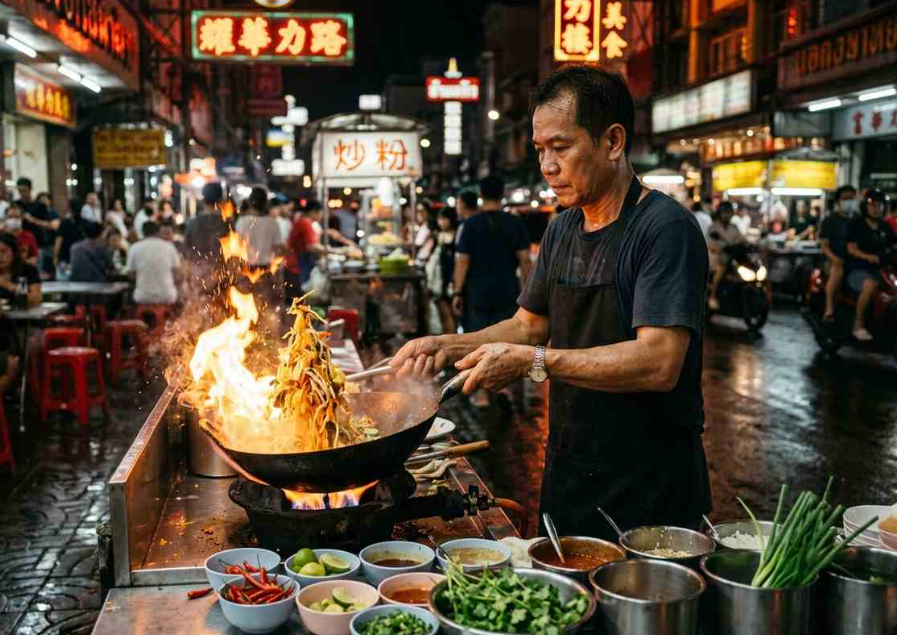
Bangkok doesn’t have a street food scene. It has a street food economy — tens of thousands of carts, shophouses and stalls feeding a metropolis where most people eat at least one meal a day cooked on a pavement.
That’s what makes eating here different. The food isn’t a novelty for visitors; it’s the everyday canteen: noodles at 7 a.m., som tam at noon, moo ping on the walk home, grilled prawns and cold beer at midnight in Chinatown.
For travellers the payoff is enormous: six or seven dishes in an evening for the price of one mid-range meal back home — and some of the best cooking in the city happens over a charcoal brazier under a plastic awning.
This guide is built to be used: the dishes worth hunting down, the neighbourhoods worth planning a day around, honest prices, what Michelin and Netflix fame really mean, plus safety, spice, airport food, Jay Fai and budgeting.
Why Bangkok Is Famous for Street Food
Three things set Bangkok apart.
Density. Walk ten minutes in almost any district and you’ll pass a dozen food options. Cooking is cheap because ingredients are cheap and the equipment is a wok, a grill and a cart.
Range. Thai food is built for the street: fast wok dishes, one-bowl noodle soups, grilled meats, pounded salads. Add Chinese, Isan (northeastern), southern Thai and Muslim traditions and one market can hold chicken rice, boat noodles, oyster omelettes and coconut ice cream.
Habit. Thais eat out constantly, and street food is normal food, not budget food — office workers and families queue at the same stalls. “Eat where the locals eat” is a practical instruction here.
The reputation followed: a Michelin Guide since 2018, a Netflix series that made a charcoal-fired cook globally famous, and food travellers who now build whole trips around Yaowarat.
15+ Must-Try Bangkok Street Food Dishes
These are typical 2026 street-stall prices. Neighbourhood markets sit at the low end; Khao San Road and central Sukhumvit run highest.
Pad Thai
Rice noodles stir-fried with tamarind, fish sauce, palm sugar, egg, tofu, dried shrimp and peanuts. Choose a stall cooking to order — the wok char is the point. ฿50–80; the egg-wrapped version at Thipsamai runs ฿120–200.
Som Tam (Green Papaya Salad)
Shredded green papaya pounded with lime, fish sauce, palm sugar, garlic, chillies and peanuts. Isan versions add fermented fish sauce and raw crab. Sour, salty and genuinely hot. ฿40–70; order “pet nit noi” (a little spicy) unless you mean it.
Mango Sticky Rice
Ripe nam dok mai mango, warm coconut-soaked glutinous rice, salted coconut cream, toasted mung beans. Best from March to June when mangoes peak. ฿60–100 locally, ฿120–150 in tourist areas.
Moo Ping (Grilled Pork Skewers)
Charcoal-grilled marinated pork brushed with coconut milk, eaten with sticky rice — Bangkok’s breakfast, snack and after-work ritual in one. ฿10–20 a skewer; morning carts near BTS stations do it best.
Boat Noodles
Small, intense bowls of pork or beef noodle soup — dark spiced broth, often with pork blood, meatballs and basil. Portions are deliberately tiny: order five to ten and stack the bowls. ฿15–30 each; the canal-side cluster near Victory Monument is the classic.
Tom Yum Goong
Hot-and-sour prawn soup with lemongrass, galangal, kaffir lime and chilli. Clear (nam sai) or creamy (nam khon). Street bowls use prawns, not lobster — ฿80–180 depending on size.
Khao Pad (Thai Fried Rice)
Day-old jasmine rice fried hard with egg, fish sauce and pork, chicken or crab, with cucumber, lime and prik nam pla. Mild, reliable, and a good test of a stall’s wok heat. ฿50–80; crab versions ฿100–200.
Thai Roti
Flaky flatbread stretched and griddled with butter, then folded with banana, egg or condensed milk. The sweet version is dessert; savoury roti with curry is breakfast. ฿30–70. Best after dark on Khao San Road and in Muslim food streets.
Hoy Tod (Oyster Omelette)
A crisp-edged, gooey-centred pancake of batter, egg and small oysters or mussels, eaten with bean sprouts and chilli sauce. Odd texture, superb flavour. ฿100–200; Nai Mong Hoi Tod in Chinatown is the benchmark and a recent Bib Gourmand pick.
Guay Teow (Thai Noodle Soup)
The umbrella term for Thailand’s noodle soups: rice or egg noodles, clear or dark broth, pork, beef or fishballs, plus a tabletop kit of sugar, chilli powder, fish sauce and vinegar. ฿40–70. Order by noodle type — “sen yai” (wide rice), “ba mee” (egg) — or just point.
Khao Man Gai (Chicken Rice)
Poached chicken over rice cooked in chicken fat and ginger, with fermented soybean-ginger sauce and clear broth. Bangkok’s comfort lunch at ฿50–80. Go-Ang Kaomunkai Pratunam is the best-known name and a repeat Bib Gourmand pick.
Grilled Seafood
River prawns, squid, whole fish and cockles grilled over charcoal, usually sold by weight along Yaowarat and at night markets. Prawns ฿150–400 each, squid ฿80–200, whole fish ฿250–500. Dip in garlic-chilli-lime sauce.
Thai Coconut Pancakes
Khanom krok — rice-flour and coconut-milk cups cooked in a dimpled pan until the base caramelises, topped with spring onion or corn. Crisp outside, molten inside, sold in trays. ฿30–50.
Sai Krok Isan (Isan Sausage)
Fermented pork sausage with rice and garlic, grilled until the skin blisters. Sour, smoky and best with raw cabbage and ginger. ฿30–50. Look for it at Chatuchak and evening Isan stalls.
Thai Milk Tea
Strong tea with condensed and evaporated milk over ice. Street carts charge ฿30–45; malls and chains double or triple it. Also try Thai lemon tea.
Also worth ordering: pad kra pao, guay jub, jok, rad na, khao moo daeng and khanom bueang.
Best Street Food Areas in Bangkok
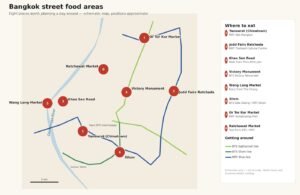
Schematic map of the eight areas below — positions are approximate. Each area has a live Google Maps link for directions.
Yaowarat (Chinatown)
The headline act. Thai-Chinese food from late afternoon into the small hours: guay jub, oyster omelettes, roast duck, dim sum, grilled prawns, fishball noodles, Chinese desserts. MRT Wat Mangkon drops you at the edge. Best 6–10 p.m.; go hungry and graze.
📍 Map: Yaowarat Road, Chinatown · MRT Wat Mangkon, Exit 3 · approx. 13.7400, 100.5100
Jodd Fairs
Now consolidated into one site: Jodd Fairs Ratchada on Ratchadaphisek Road beside Big C Place, three minutes from MRT Thailand Cultural Centre (Exit 4). Daily, roughly 5 p.m.–1 a.m. Come for leng saeb (volcano pork ribs), grilled seafood, giant river prawns and desserts, with live music and proper seating. Slightly pricier, much easier.
📍 Map: Jodd Fairs Ratchada · MRT Thailand Cultural Centre, Exit 4 · approx. 13.7656, 100.5697
Khao San Road
Not the city’s best cooking — its easiest introduction. Pad thai carts, skewers, fruit shakes, roti and fried insects with English menus everywhere. Tourist-tier prices (฿80–200): a lively first night, then move on.
📍 Map: Khao San Road · walk from Phra Athit pier · approx. 13.7590, 100.4970
Victory Monument
Home of the boat-noodle alley: small bowls at ฿15–30 and a growing stack of empties beside you. Local, lunch-to-early-evening, five minutes from BTS Victory Monument, and one of the cheapest satisfying meals in town.
📍 Map: Boat noodle alley, Victory Monument · BTS Victory Monument, Exit 4 · approx. 13.7649, 100.5386
Wang Lang Market
On the Thonburi side by Siriraj Hospital, via ferry from Tha Chang or Tha Prachan. Narrow lanes of southern Thai food, fried chicken, grilled squid, sweets and khanom bueang, mostly for locals. Best 10 a.m.–4 p.m.; pairs with a river crossing.
📍 Map: Wang Lang Market · ferry from Tha Chang or Tha Prachan · approx. 13.7578, 100.4868
Silom
A business district that eats well at lunch: Convent Road and the side sois fill with carts from about 11 a.m. to 2 p.m. — noodle soups, chicken rice, som tam, grilled chicken. Evenings shift to street-side restaurants, with Bang Rak and Charoen Krung nearby.
📍 Map: Convent Road, Silom · BTS Sala Daeng (Convent Road side) · approx. 13.7266, 100.5342
Or Tor Kor Market
Bangkok’s most orderly food market, opposite Chatuchak at MRT Kamphaeng Phet (Exit 3), roughly 6 a.m.–8 p.m. Premium fruit, prepared curries, seafood and desserts. Pricier than a neighbourhood market, ideal if you’re nervous about hygiene or buying curry pastes to take home.
📍 Map: Or Tor Kor Market · MRT Kamphaeng Phet, Exit 3 · approx. 13.7995, 100.5503
Ratchawat Market
An old neighbourhood market on Nakhon Chai Si Road in Dusit, well off the tourist trail: noodles, roast duck, curries, satay and sweets, barely any English. Go 7 a.m.–2 p.m.
📍 Map: Ratchawat Market · taxi from BTS/MRT (no station nearby) · approx. 13.7795, 100.5235
Best Street Food in Bangkok at Night
Bangkok after dark is the main event: the city cools, the grills fire up, and whole streets become kitchens — which is how most visitors end up experiencing Bangkok street food at night.
Chinatown leads. Yaowarat from about 6 p.m. is the densest concentration of good food in Thailand — all within a ten-minute walk.
Then the night markets. Jodd Fairs Ratchada (daily to 1 a.m.), Train Night Market Ratchada (reopened at its original site behind Esplanade in March 2026, Thursday–Sunday), Liabduan Danneramit, Srinakarin train market (Thursday–Sunday), and Huai Khwang, which keeps serving until 3 a.m. or later.
Eat after dark: grilled river prawns, moo ping, pad kra pao with a fried egg, som tam with grilled chicken, hoy tod, boat noodles, then mango sticky rice.
Practical: bring cash and small notes, expect to share plastic stools, and note that the last BTS/MRT trains leave around midnight — plan a taxi if you stay out later.
Bangkok Street Food and Michelin Stars
Bangkok’s Michelin Guide began in 2018; the 2026 Thailand guide lists roughly 468 venues nationally, about 137 of them Bib Gourmands. Two awards matter for street food:
- A star is judged on the food alone. In Bangkok, exactly one street-side operation has held one: Jay Fai.
- Bib Gourmand means good food at moderate prices. This is where street-food value lives, and the list shifts year to year.
Names on recent Bib Gourmand or Selected lists include Nai Mong Hoi Tod, Guay Jub Ouan Pochana, Go-Ang Kaomunkai Pratunam, Charoen Saeng Silom, Polo Fried Chicken, Jok Prince, Rung Rueang and Lim Lao Ngow. Thipsamai remains one of the city’s most famous plates even as its guide listing has changed between editions — check the current guide, not old blog posts.
What recognition actually means: more visitors, longer queues, often a price rise — not necessarily a better meal than the stall two doors down with a queue of office workers. A Bib Gourmand bowl costs ฿60–100; the starred omelette costs more than ten times that.
Bangkok Street Food on Netflix: Street Food Asia
Netflix’s Street Food: Asia premiered on 26 April 2019. Episode 1, “Bangkok, Thailand” (about 30 minutes), tells Jay Fai’s story alongside other veteran vendors — including Khun Suthep’s hand-pulled barbecue pork noodles and Jek Pui, the Yaowarat curry stall known for red plastic stools spilling onto the pavement. It’s narrated by Bangkok food writer Chawadee Nualkhair, author of Bangkok’s Top 50 Street Food Stalls, which gives the series unusually good local grounding.
Why it matters: the episode is the main reason visitors now ask for “the Netflix street food in Bangkok”. Go early or late and verify locations first — several featured stalls have moved since 2019.
For Jay Fai, the practical information is simple: cash only, no reliable reservations, queue before opening, and check current opening days before you travel.
Who Is the Queen of Street Food in Bangkok?
“Queen of street food” is the title the Thai and international press gave Jay Fai — real name Supinya Junsuta — and it stuck after the Netflix series.
She cooks every dish herself over two charcoal braziers at an open-fronted shophouse at 327 Maha Chai Road in the Old City, near Wat Saket — wearing ski goggles against the sparks. Her signature crab omelette (khai jeaw poo) is a dense golden roll holding roughly 300–400 g of hand-picked blue swimming crab.
Before you go:
- Michelin star since 2018, retained in the 2026 guide — still the only street-side shop in Bangkok with one.
- The omelette is listed at around ฿1,500; a premium version has been reported at ฿4,000. In August 2025 the shop was fined ฿2,000 for not displaying the higher-priced option and ordered to list both prices. Confirm what you’re ordering.
- Other dishes cost less — drunken noodles with seafood run roughly half the omelette price.
- Budget ฿1,500–3,000 for two with drinks, bring cash, and treat it as a bucket-list event rather than a cheap meal.
- Queues form well before opening, and she has publicly discussed retiring — check the shop is still operating before planning a trip around it.
Bangkok Street Food at the Airport
You can eat Thai food at both airports, but it’s nothing like the city.
Suvarnabhumi (BKK): the best value is Magic Food Point on Level 1 of the main terminal (landside, near Gate 8), open 24 hours with up to about 20 Thai stalls. Prices start around ฿30, with most dishes ฿40–70 — real street-food pricing. Some outlets use a prepaid card or coupons bought at a counter, so keep cash handy. Airports of Thailand says concession prices are capped at about 20% above market rates, and airside restaurants still run ฿200–500 for a main.
Don Mueang (DMK): smaller and more utilitarian, with fewer cheap Thai kitchens — mostly chains, cafés and a handful of Asian outlets at ฿80–250. If you want one last bowl of noodles at street prices, eat before you leave the city.
Order before departure: pad thai, khao man gai, boat noodles, green curry, mango sticky rice — knowing the city version is cheaper and better. Magic Food Point is landside, so transiting passengers without immigration clearance are limited to airside outlets.
Bangkok Street Food Buffet: Is It Worth Trying?
Thai buffets and street food are different formats, and the distinction matters.
- Street food is cooked to order at a cart or shophouse, usually by a specialist doing one thing well: cheap, fast, full of wok heat.
- Buffets come in forms: mookata (Thai barbecue hotpot, grilling pork and seafood at the table) at roughly ฿250–500 per person; suki chains; mall and hotel buffets from ฿400 to ฿1,500+; and seasonal temple-fair spreads at very low prices.
Worth it? For groups, mookata is fun and good value — a sociable night out for about ฿300 each. Mall and hotel buffets are better judged as “Thai food, unlimited”. If authentic eating is the goal, spend the money on a crawl instead: three or four street dishes and a drink will beat a buffet on flavour for less than a hotel spread.
Bangkok Street Food Prices: How Much Should You Budget?
Real 2026 ranges: neighbourhood stalls at the low end, Khao San Road and visitor-facing night markets at the top.
| Category | Dish | Typical price (THB) | Approx. USD |
|---|---|---|---|
| Noodles | Pad thai | ฿50–80 | $1.50–2.50 |
| Noodles | Boat noodles (per small bowl) | ฿15–30 | $0.50–1 |
| Noodles | Guay teow noodle soup | ฿40–70 | $1.20–2 |
| Rice | Khao man gai | ฿50–80 | $1.50–2.50 |
| Rice | Khao pad / pad kra pao | ฿50–80 | $1.50–2.50 |
| Rice | Crab fried rice | ฿100–200 | $3–6 |
| Meat | Moo ping (per skewer) | ฿10–20 | $0.30–0.60 |
| Meat | Grilled chicken / Isan sausage | ฿30–80 | $1–2.50 |
| Desserts | Mango sticky rice | ฿60–100 | $2–3 |
| Desserts | Khanom krok / roti | ฿30–70 | $1–2 |
| Drinks | Thai milk tea / bottled water | ฿20–45 | $0.60–1.40 |
| Seafood | Grilled squid | ฿80–200 | $2.50–6 |
| Seafood | Grilled river prawns (each) | ฿150–400 | $4.50–12 |
| Seafood | Whole grilled fish | ฿250–500 | $7.50–15 |
Daily budgets, food only: ฿200–400 for three street meals and snacks where locals eat; ฿500–800 for a comfortable day mixing markets, coffee and a sit-down meal; ฿1,000+ if seafood, alcohol or a Michelin stall is involved. USD figures assume roughly ฿33 to $1 — check the current rate.
Bangkok Street Food Safety Tips
Bangkok street food is generally safe, and millions of locals eat it daily. The realistic risks are unfamiliar spice, a stomach adjusting to new bacteria, and the occasional stall that’s been sitting out too long.
- Choose busy stalls. High turnover means fresh food and hot woks. A queue of Thai customers is the best signal you’ll get.
- Order what’s cooked in front of you. Stir-fries, soups and grills are low-risk; be warier of pre-plated food at room temperature, cut fruit in the heat, and raw or fermented dishes.
- Ice and water. Ice in Bangkok is almost always commercially made in sealed tubes and is fine. Bottled water is cheap; skip the tap.
- Allergies. Peanuts, shrimp paste, shellfish and egg are everywhere, and cross-contamination is normal in a one-wok kitchen. With serious allergies, carry a Thai allergy card and choose restaurants with clearer kitchens.
- Vegetarian and vegan. Look for the yellow “jay” (เจ) flag — the Thai-Chinese vegan tradition, stricter than “vegetarian”. Otherwise say “mang sa wirat” and expect fish sauce unless you ask.
- Halal. Look for the green halal logo or a “Muslim food” sign; such stalls are common around Charoen Krung, Nana and Ramkhamhaeng, and chicken skewers are safer than pork.
- Spice. “Pet nit noi” still means spicy. Say “mai pet” for none — and don’t drink tap water to cool down.
Six phrases that help: thao rai? (how much?), pet nit noi (a little spicy), mai pet (not spicy), ao an ni (this one), nam plao (bottled water), mang sa wirat (vegan).
Best Time to Explore Bangkok Street Food
- Morning, 6–9 a.m.: the most underrated window — moo ping carts, jok rice porridge, patongo with condensed milk, coffee carts, and fresh markets at their best.
- Lunch, 11 a.m.–2 p.m.: the peak. Office districts like Silom empty out and shophouse kitchens run at full speed. Most stalls sell out of their specialty by mid-afternoon.
- Evening, 5–9 p.m.: grills, woks and night markets fire up. Best variety and atmosphere.
- Late night, 9 p.m.–2 a.m.: Yaowarat, Huai Khwang and the night markets. Some of the best eating happens after the last train.
Seasonally: November to February is cool and dry — the best time to walk between stalls. March to May is hot (35°C+), so eat earlier or later. June to October brings short downpours, fewer crowds and cheaper hotels. Avoid big crawls during Songkran (mid-April), when much of the city closes or joins the water fights.
Bangkok Street Food vs Other Food Destinations
| City | Strength | Trade-off |
|---|---|---|
| Bangkok | Range, 24-hour availability, extraordinary value | Fewer English menus outside tourist zones; real spice |
| Hanoi | Depth within one tradition (pho, bun cha, egg coffee) | Less variety in a single evening |
| Penang | Hawker centres and heritage food culture | Less late-night eating |
| Singapore | Clean, easy, world-class hawker centres | Much higher prices |
| Taipei | Night markets and great infrastructure | Milder flavours, fewer specialists |
What makes Thai street food distinctive is the balance of sweet, sour, salty and hot in nearly every dish, cooked fast over high heat, in a city that never closes.
One search note: queries like “street food Bangkok Paris”, “street food Bangkok Bastille” or “street food Bangkok Bristol” are usually people looking for Thai street food near home — Bastille in Paris and central Bristol both have their own Southeast Asian eating scenes — not places in Bangkok. They’re not Bangkok destinations, so they don’t appear above; if you’re searching from Europe, check local listings and a restaurant’s own menu rather than a travel keyword.
Frequently Asked Questions About Bangkok Street Food
Where is the best street food in Bangkok?
Yaowarat (Chinatown) for range and night energy, Victory Monument for boat noodles, Or Tor Kor for a clean, organised market, Jodd Fairs Ratchada for the easiest night market. Best all-round pick: Yaowarat after 6 p.m.
What is Bangkok’s most famous street food?
Pad thai internationally; Jay Fai’s crab omelette thanks to Michelin and Netflix. Locally, pad kra pao and noodle soups are the everyday favourites.
Is Bangkok street food cheap?
Yes. Most dishes cost ฿40–80 (about $1.20–2.50), and you can eat well for ฿200–400 a day. Touristy areas charge two to three times more.
Is Bangkok street food safe to eat?
Generally yes. Eat at busy stalls, order food cooked in front of you, drink bottled water, and give your stomach a day before going hard on chilli and fermented dishes.
Where can I find street food in Bangkok at night?
Yaowarat, Jodd Fairs Ratchada (daily to 1 a.m.), Train Night Market Ratchada (Thursday–Sunday), Liabduan Danneramit, Srinakarin train market and Huai Khwang.
Who is the queen of street food in Bangkok?
Jay Fai — Supinya Junsuta — the ski-goggle-wearing chef on Maha Chai Road with one Michelin star and a famous crab omelette.
Which Bangkok street food vendor was featured on Netflix?
The Bangkok episode of Street Food: Asia (2019) features Jay Fai, Khun Suthep’s barbecue pork noodles and Jek Pui’s curry stall. Some featured vendors have moved since filming.
Is there Michelin-star street food in Bangkok?
Yes, one: Jay Fai, starred every year since 2018 and still starred in the 2026 guide. Many more street vendors hold Bib Gourmand status for good food at fair prices.
What is the best street food market in Bangkok?
For visitors, Jodd Fairs Ratchada (daily, easy by MRT) or Yaowarat. For calm and quality, Or Tor Kor. For a local experience, Ratchawat or Wang Lang.
Can you find street food at Bangkok airport?
Yes. Suvarnabhumi’s Magic Food Point (Level 1, landside, 24 hours) serves Thai dishes from around ฿30–70. Don Mueang has fewer cheap options and higher prices than the city.
What is the best month to visit Bangkok for street food?
November to February — dry, cooler and comfortable for walking between stalls, with every market in full swing.
How much money should I budget for street food in Bangkok?
฿200–400 per person per day for three street meals and snacks; ฿500–800 for a comfortable day; ฿1,000+ if you add seafood, drinks or a starred stall.
Final Thoughts: Experience the Best of Bangkok Street Food
The best Bangkok street food plan isn’t a list — it’s a route. One morning at a neighbourhood market, one lunch where the carts feed office workers, one evening grazing through Yaowarat, one night market for the grilled prawns.
Eat where the queue is, order what you can’t identify, carry small notes, and don’t skip dessert. And if Jay Fai’s omelette is on your list, budget the time and money for it — then spend the rest of the trip eating just as well for a fraction of the price.
Planning more of Thailand? Explore our other guides to Thai dishes, Bangkok neighbourhoods and the country’s best food markets — and start with one neighbourhood you’ve never heard of.
